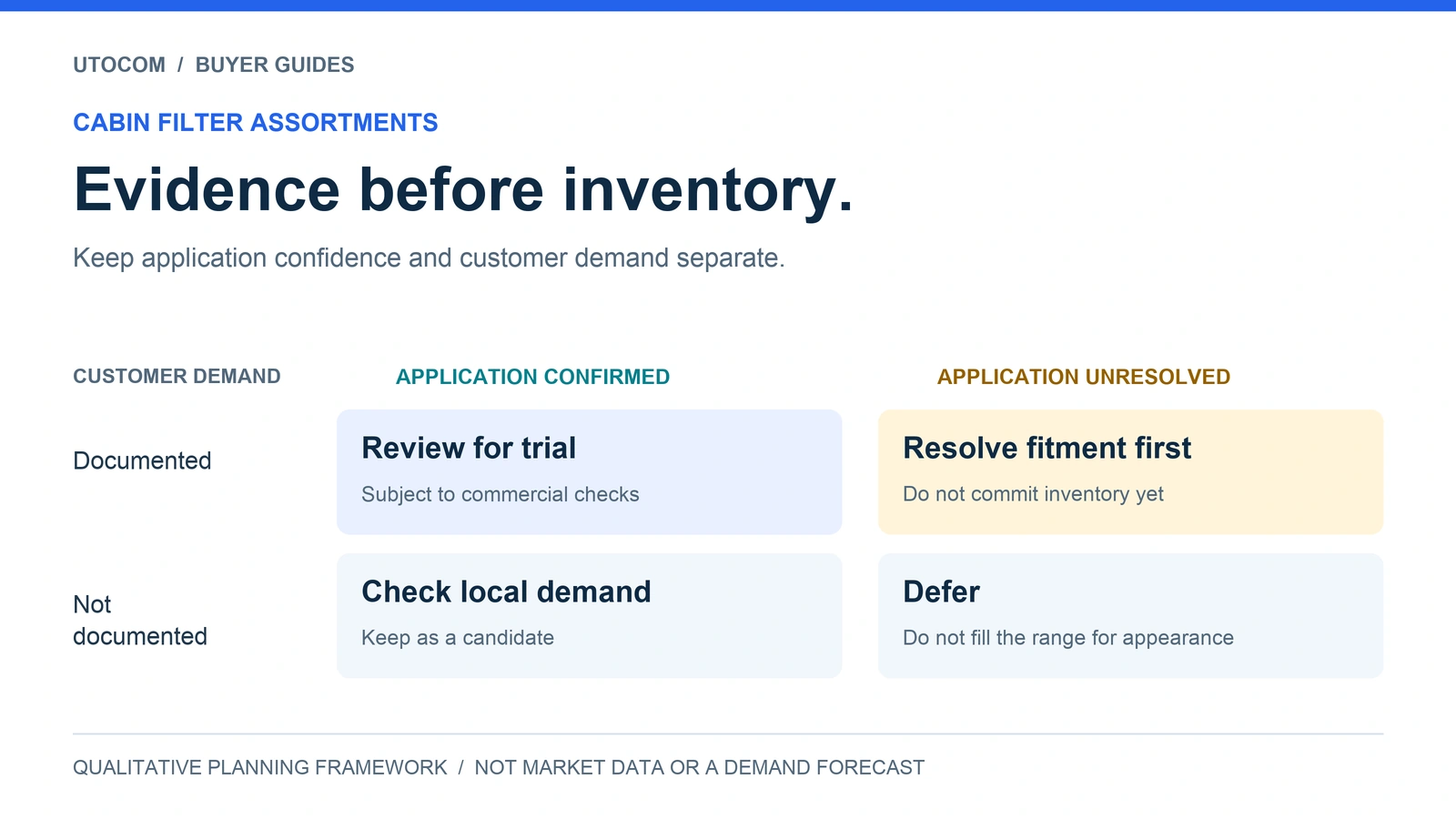
A useful cabin filter assortment starts with the vehicles your customers actually service and the references you can verify. Without reliable local demand and fitment data, a long supplier catalogue is a pool of candidates, not evidence for buying every SKU.
Build two separate records: one for application confidence and one for demand evidence. A part can be well identified but have little local demand. Another can attract customer enquiries while still lacking a confirmed application. Those situations require different actions.
Define the market you can actually observe
Write down the territory and customer group for the trial: for example, your existing independent workshop accounts in one region. Do not use worldwide vehicle popularity as a substitute for their service mix.
Collect available invoices, repeated customer requests, lost-sale records and workshop reference lists. Record the period covered and whether requests came from separate customers. If you have only a few conversations, call the list an initial hypothesis; do not describe it as a proven bestseller ranking.
This article provides a planning method. It has no country-specific vehicle sample and supplies no market-share, sales-volume or guaranteed turnover estimates.
Build the fitment record before consolidating SKUs
For each candidate, save the complete OE or aftermarket reference, product type, catalogue source and access date, application restrictions, dimensions and frame details. Note the media variant and whether one saleable unit contains one element or a set.
A real catalogue example shows why this matters: the MANN-FILTER CUK 23 004-2 listing identifies an activated-carbon filter, dimensions, application data and two included products. This illustrates the fields to collect; it is not a UTOCOM equivalence claim or a recommendation to stock that reference.
Do not merge two candidate records solely because a cross-reference list connects them. Confirm application restrictions, physical construction, media option and pack contents. One physical format may also have separate saleable variants. Preserve those distinctions in the order and warehouse labels.
Sort candidates into actions, not a false popularity score
| Application evidence | Demand evidence | Trial action |
|---|---|---|
| Confirmed for the intended application and version | Repeated, documented customer requirements | Consider for the opening assortment, subject to commercial review |
| Confirmed | Little or no local evidence | Keep as a candidate; seek customer demand before increasing stock |
| Unresolved or conflicting | Documented requests | Resolve fitment or sample questions before an inventory commitment |
| Unresolved | Little or no evidence | Defer; do not fill out the range for appearance alone |
These are editorial decision categories, not calculated demand forecasts. A distributor can adapt them to its own return risk and cash constraints.
Limit variants deliberately
Separate the question “Which applications should we cover?” from “Which media options should we offer for each application?” Otherwise, adding several options to every fitment can multiply inventory before the underlying demand is known.
Use the existing cabin filter selection guide when comparing product options. This assortment plan does not assume that every medium is available for every frame or that a premium description proves a performance claim. Confirm the exact version and evidence needed for your market.
For each proposed addition, record what customer requirement it meets, whether it duplicates an already approved saleable item, and what would justify reordering it. Keep uncertain alternatives out of the confirmed coverage count.
Plan quantities only after the shortlist is defensible
Review quantity by reference, supplier minimums, lead time, packaging and cash commitment. A total order quantity does not establish that each SKU meets its own purchasing requirements. Our mixed-SKU trial-order guide covers the wider order mechanics; this article focuses on deciding which cabin-filter lines should enter that order.
There is no universal “correct” number of opening SKUs. Use what your evidence and budget support. Keep special-order candidates visible without counting them as available stock.
Measure the trial with reasons attached
Record units sold by SKU, distinct buying customers, stockouts, returns and the reason for each fitment complaint. Separate a wrong catalogue match from a damaged package or an unwanted media option. These lead to different corrections.
Before expanding the assortment, compare the trial with the original customer requests. Investigate unpurchased lines and repeated unfilled enquiries. Avoid turning one early sale into a broad demand claim, or treating a return caused by mislabelling as proof that the underlying application has no demand.
Prepare a shortlist for review
- Territory and intended workshop or distributor customers.
- Complete references and their catalogue evidence.
- Known application restrictions and unresolved questions.
- Requested media version and unit or set contents.
- Actual customer demand evidence, with dates.
- Proposed quantities by SKU and destination country.
Browse UTOCOM cabin filters, or use the vehicle finder as a starting point for listed passenger-vehicle applications. Verify each final match before counting its coverage.
For a quotation, send the model list, quantities by SKU and destination country. If a reference is uncertain, start with its complete marking or label photo. Ask which lines are ready to quote and which still need fitment, specification or availability checks.
Need help matching a filter?
Send the complete reference or a clear label photo to start. You can attach photos in WhatsApp or your email.
Quote email: janna@utocom.com
Review and send in WhatsApp or your email app. You can also copy the email address into your webmail.