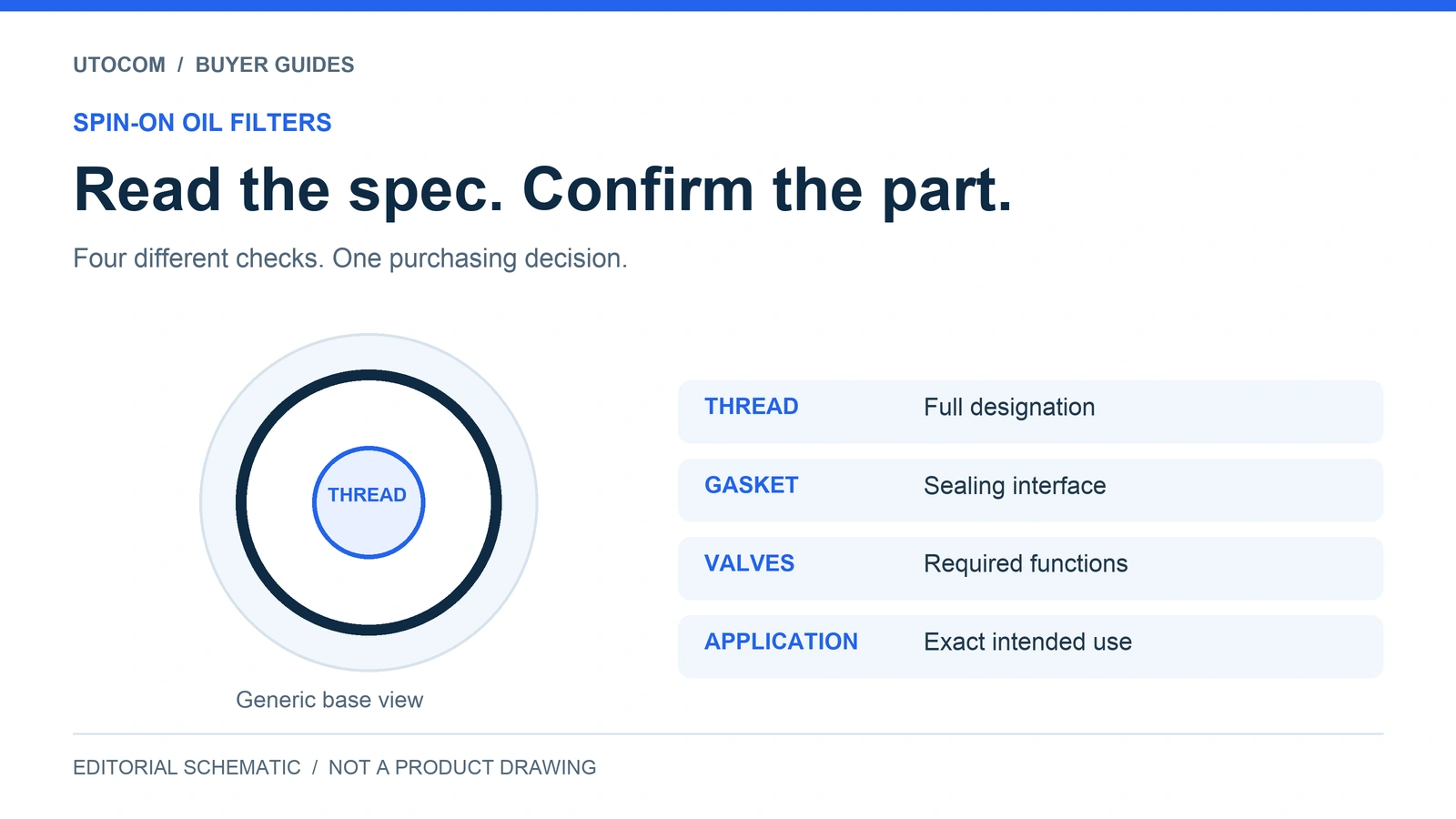
A spin-on oil filter specification sheet should tell you more than the height and diameter of the metal can. For a replacement enquiry, read the complete reference, thread designation, gasket dimensions, installation clearance and valve information together. If a required field is missing, keep that item open rather than treating a similar-looking filter as an approved match.
This guide is about interpreting purchasing information. If you first need to distinguish a complete spin-on unit from a replaceable cartridge, see spin-on versus cartridge oil filters.
Start with the document identity
Save the supplier's part number, the original reference, document date or revision, and the product version being offered. Ask whether a drawing describes the sample, the proposed production item or a different variant. A reference copied into a spreadsheet does not establish that all three are the same.
Keep the complete original number alongside any normalized search version. Do not delete a final digit or letter. Use the filter catalogue search to find candidates, then use the cross-reference verification guide to evaluate them.
Read the thread and the sealing surface separately
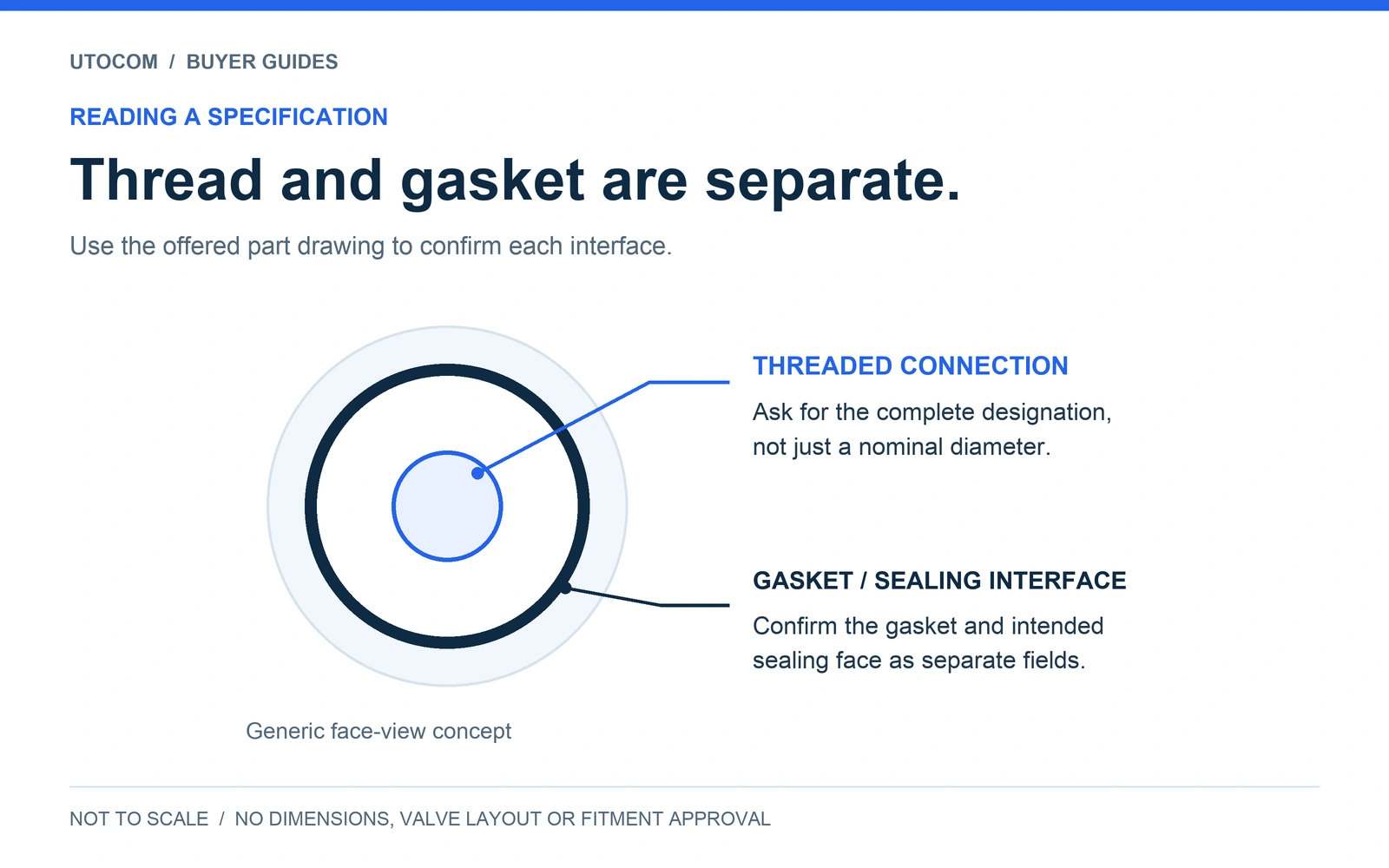
A thread designation includes more information than its nominal diameter. Preserve the pitch or threads-per-inch notation and the thread system shown on the drawing. An incomplete description such as “20 mm thread” is a request for clarification, not a purchase specification. The Filter Manufacturers Council's application bulletin explains why apparent mounting compatibility does not establish the correct application.
Next, identify the gasket's inner diameter, outer diameter and the intended sealing face. Compare these with the relevant drawing and application information. A can that screws onto a mounting stud has not thereby demonstrated that its gasket seals correctly.
Manufacturer catalogues illustrate why these are separate checks: the MANN-FILTER W 67 page lists body dimensions, gasket dimensions, thread and valve fields individually. This is an example of catalogue structure, not a suggested equivalent to any UTOCOM item.
Do not read a valve figure as a universal requirement
A filter's bypass valve opens when the pressure drop across the filter reaches its specified threshold. The Donaldson guide to full-flow filtration explains when a bypass valve may open. An anti-drainback valve helps hold oil in the filter after shutdown, as described in FMC bulletin 83-2.
For purchasing, ask whether each valve is required for the particular application, where the relevant bypass function is located, and what the stated value and unit mean. Do not copy a setting from another engine or assume that an empty catalogue field means “not required.” This article supplies no universal pressure setting, tightening instruction or installation approval.
Use this specification review table
| Field | What to record | When to hold the line for review |
|---|---|---|
| Identity | Full original reference, offered SKU, drawing revision | Number or quoted version is incomplete |
| Thread | Complete designation, including pitch or TPI | Only diameter is stated, or sources disagree |
| Gasket | ID, OD, sealing-face details and units | The seat position or measurement points are unclear |
| Envelope | Overall height, body diameter and required clearance | The proposed unit cannot be checked against its installation space |
| Valves | Required functions, location where relevant, setting and units | A blank or unexplained value is treated as approval |
| Performance | Relevant report, tested reference and conditions | A material description is offered as proof of complete-filter performance |
| Order control | Approved version, packaging identification and open actions | Sample and production specification are not connected |
Separate a fit check from a performance claim
An external measurement can help assess physical compatibility. It cannot establish contaminant-removal performance, capacity or a suitable service interval. Ask which exact filter version a performance report covers and how it relates to the item being quoted. A general description such as “synthetic media” is not a replacement for that evidence.
For a new reference, keep the dimensional review, application check and sample inspection as separate approvals. A sample may reveal a physical mismatch; a successful installation check alone does not validate every operating characteristic. A qualified person should assess the application using the relevant vehicle and filter documentation.
Send a short, useful clarification request
List each missing field against its SKU. Request an annotated drawing and the application basis, then identify which sample or production version needs approval. If two documents conflict, ask the supplier to resolve the difference in writing instead of averaging measurements.
Browse UTOCOM oil filters for candidate references. For a quotation, include the reference, quantity and destination country. For help identifying the filter, start with the full reference or a clear label photo. Ask for any missing specifications before approving the order.
Need help matching a filter?
Send the complete reference or a clear label photo to start. You can attach photos in WhatsApp or your email.
Quote email: janna@utocom.com
Review and send in WhatsApp or your email app. You can also copy the email address into your webmail.
Frequently Asked Questions
Is the same thread enough to approve an oil filter?
No. Review the sealing interface, dimensions, application and required functional features as well.
What if the sheet has no valve information?
Request clarification for the intended application. A missing field does not prove that a valve is unnecessary.
Does a larger can mean a better replacement?
Size alone does not establish suitability or performance. Use the applicable specification and evidence, rather than choosing by appearance.